Sunday, September 13, 2009

Worlds largest navy is unknown.


Off the coast of Singapore is the worlds largest fleet of ships. They have no crews, no cargo and no destination.

They are parked here because of the global recession that governments around the world would rather that you ignore.

The rates for shipping have declined drastically in the last 10 months. Back then it used to cost about $50,000 a day to charter a 80,000 ton ship now it is about $6,000 a day.

The number of ships joining this fleet continue to expand and is now over 500. While shipping declines by 8% a year new ships that equal 12% of global capacity are still being built . That means that the surplus of ships is growing due to orders that were placed up to 3 years ago.

The Baltic Dry Index measures all this and this shows that global shipping is still in decline and the global economy cannot improve if this is the case.

Saturday, September 12, 2009

Annapurna 1


This is a view of Annapurna 1 taken from the north. This mountain is the 10th highest on our planet but has the worse climbing fatality rate. 40% of the people who have tried to climb this mountain have died in the attempt. This totals over 60 climbers 5 of which have just disappeared, never to be seen again. Most of the deaths were caused by avalanches which are very common on this mountain.
The mountain which has the dubious distinction of having the second highest fatality rate is K2. K2 is the worlds second highest mountain but does not have so many avalanches. Serious climbing like this is probably the worlds most dangerous activity and certainly the worlds most dangerous sport.

Saturday, September 5, 2009

Stick charts

These may look like simple stick decorations but they had a much more serious purpose.

The Polynesians were spread out over thousands of islands in the central and southern Pacific ocean. They were master navigators who made their way over this vast expanse of empty ocean without any of the navigation aids we associate with navigation.

This was only possible because they were keenly aware of the ocean, winds, weather and stars and they used that knowledge to determine which way to go. Individual navigators made 'stick charts' using cowrie shells to represent islands, thin strips of palm fronds displayed the routes and wave patterns. These charts were not taken on these long voyages but the navigator memorized what he needed to know. This knowledge was passed on to others on the voyages and it took many years of experience to become a master navigator. Some of these voyages have been duplicated in recent years but like many of the skills that previous generations perfected the art of navigating by listening to the environment is mostly lost in Polynesia.

Friday, September 4, 2009

CCD, Coloney collapse disorder

In 2007 honey bees suffered from the worst fatality rate ever known. In many case over 50% of the bees died whereas 20 years ago less than 10% was normal. In the last two years the reasons for CCD have become better known and it turns out that there are a number of causes. Mites are a bigger problem. The bees are more stressed due to their higher workload and this makes them more vulnerable to viruses. Some colonies have three viruses and this makes the stressed bees less likely to survive. The bees nutritional health has deteriorated and this means that the bees are less able to fight the problems that may come their way.
As a result of CCD beekeepers are now taking better care of their bees and their health is improving. In the last two years the winter loss rate has been about 35 and 30 percent. Not good but getting better. Pesticides are also a factor and obviously this is something bees did not have to deal with before the introduction of pesticides. Another factor that was covered in a recent post is the vast part of North America that is now paved or built on. Obviously bees cannot survive in a concrete jungle.
There are two things that many people can do to help the bees. Plant lots of flowers and stop using pesticides. The research is incomplete but the wild bees have also been seriously affected by the deteriorating environment that we hmans have caused.

Thursday, September 3, 2009

Fastest human ever

On July 6, 2006, 'Fast Freddie' Markhan pedaled 53.43 miles in one hour to set a new worlds speed record for human powered travel. Fast Freddie was the first person to travel 50, 60 and 65 miles per hour using muscle power alone and Fast Freddie was almost 50 years old at the time.

The picture shows his bike and the bike in the background is the same kind of bike without the cover on. As you can see it is a very aerodynamic bike and the reason Fast Freddie was so fast.

First full pressure suit.

This pressure suit was designed and built by Spanish Colonel Don Emilio Herrera Linares in 1934 and 1935. He was going to use it in an open balloon which he want to fly into the stratosphere. This would have been higher than any one else had flown at that time. This effort was canceled when the Spanish Civil War started in 1936. Although this war was a disaster for millions of people it may have save the colonel's life as many things could have gone wrong on his planned flight.

Wednesday, September 2, 2009

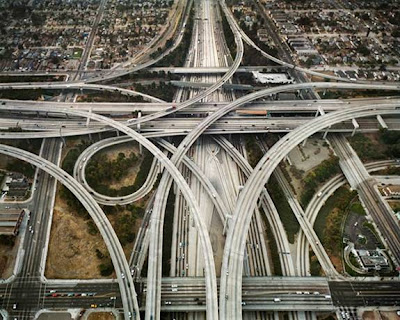
Pavement, lotsa pavement.


Roads and payment in North America total about 100,000,000 acres. This is about 90,000 times more than greater Vancouver. Not only was a huge amount of energy used to create all this paved land but an even larger amount of energy is used move cars and trucks along this pavement.

With this money a very efficient train system could have been built using about 20% of the land and energy we use today. This train system would not only be much more efficient but it would also be much faster. In many large cites the commuting car traffic is actually slower than horses were before the car was invented.

So it is a great shame that the leadership in many countries has so little vision and so frequently make such poor long term decisions. Here in British Columbia the government has announced that it will replace a bridge with a new 10 lane bridge at a cost of almost $4 billion. Or as Everett Dirksen was supposed to have said, "A billion here and a billion there and pretty soon you are talking real money."